ServicesVehicle Restraints
Vehicle Restraints in Nanticoke
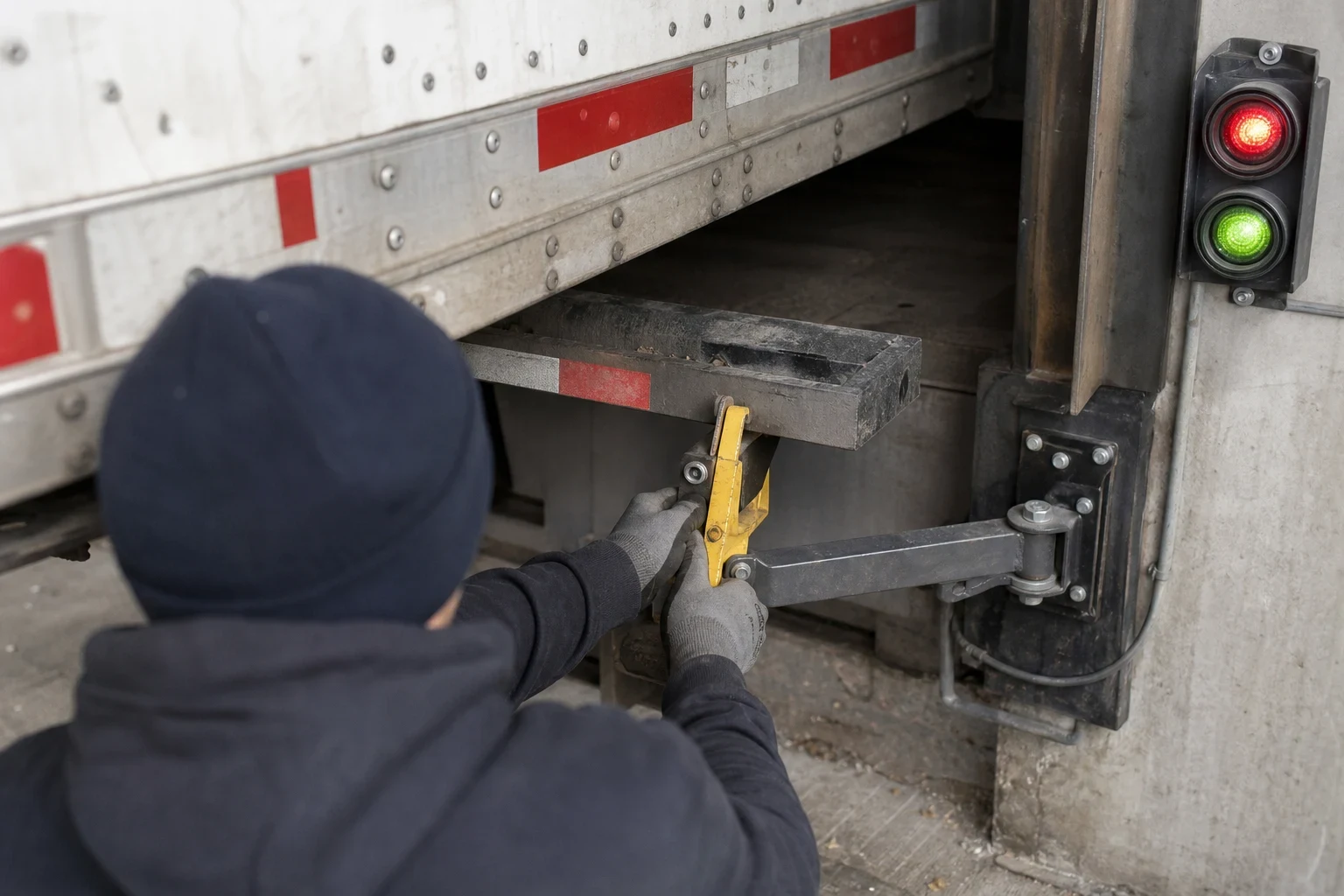
A vehicle restraint holds the trailer against the dock while forklifts cross into it. We repair, adjust and install restraints and their light systems, and we photograph the hook, carriage and controls before and after so you can see the work.
Keeping the trailer where it belongs
A restraint exists to stop two things: a driver pulling away while a forklift is still inside, and trailer creep, where the trailer inches forward each time a loaded lift drives on and off. Either one can open a gap between the dock leveler lip and the trailer bed. A restraint that engages reliably and tells the driver and the dock crew the truth through its lights is one of the most important safety devices at a receiving door.
Most restraints we see are hook-style units that rise and catch the trailer's rear impact guard, sometimes called the RIG or ICC bar. Others hold a wheel instead of the bar, which helps with trailers whose guards are bent, missing or mounted too low. We work on both, and we explain which one suits your trailers instead of pushing the newest model.
Every visit ends with a short photo record. You see the worn pivot or the corroded sensor as we found it, then the replaced part and the adjusted unit, so maintenance managers and safety staff have something real to file.
What our restraint work covers
- Hook and carriage repair
- We check the hook for bending and wear, then inspect the carriage, track and return springs. Debris and packed grit in the track are a common reason a hook stalls partway up.
- Motor, hydraulic and manual drives
- Powered units get the motor, pump, hoses and seals inspected for leaks and weak operation. Manual restraints get their handles, linkages and ratchets checked for smooth, positive engagement.
- Light communication systems
- The red and green lights inside and outside the door are how the driver and forklift operator know whether the trailer is held. We test them against the actual hook position so the signal matches reality.
- Sensors and limit switches
- A misaligned sensor can show green when the hook has missed the bar. We realign or replace switches and confirm the stored, engaged and fault positions each read correctly.
- Interlocks with levelers and doors
- Where your setup ties the restraint to the dock leveler or overhead door controls, we confirm the sequence works as designed so a leveler cannot deploy before the trailer is secured.
- New restraint installation
- When a unit is beyond sensible repair, we install a replacement matched to your dock face, trailer mix and existing controls.
When a restraint is telling you something
Some trailers slip past the hook
One trailer catches and the next one doesn't. Worn hook teeth, a tired return spring or bent guards on the trailers themselves can all cause it, and each calls for its own fix.
Lights that disagree with the hook
Green outside while the hook sits low is a serious fault. Treat the door as unsecured until it is checked.
Slow or uneven movement
A hook that hesitates, chatters or stops short usually points to track debris, a tired motor or low hydraulic pressure.
Crews overriding the system
When operators routinely use the bypass because the restraint is unreliable, the safety device has stopped doing its job. That habit is worth fixing at the source.
Rust and winter damage
Road salt, slush and freeze-thaw cycles in winter are hard on low-mounted carriages and pivots. Heavy scale or seized joints after a cold season are a clear prompt for service.
What affects the cost of restraint work
Restraint work is priced from what we find at the door, not a flat figure. A sticking hook that needs cleaning and adjustment is a very different job from a seized carriage or a full replacement. We explain each line on the estimate so you can decide with the condition of the unit laid out in front of you.
Type of restraint
Manual, electric, hydraulic and wheel-based units each use different parts and take different amounts of labor.
Repair or replace
Replacing a switch or spring is a small job. A badly corroded carriage or a failed drive may make a new unit the better use of your budget.
Parts for your model
Common parts are easy to source. Older or discontinued units can take longer and cost more to keep running.
Controls and interlocks
Rewiring lights or tying the restraint into leveler and door controls adds time beyond the restraint itself.
Number of doors and timing
Servicing several docks in one visit is usually more efficient, and working around peak receiving hours can affect scheduling.
How a service visit runs
- 1
A conversation first
On the phone, we ask about the make, the symptoms and when your dock is quietest. That lets us plan around your shipping schedule.
- 2
Inspection at the door
We cycle the restraint, test the lights and look closely at the hook, carriage, drive and sensors. We photograph each problem as we find it.
- 3
A straight answer on the fix
We go over what we found and tell you honestly whether a repair will hold or a new unit is the wiser spend. You get a written, line-item estimate, and nothing is touched until you approve it.
- 4
The repair and a full test
We complete the work, then cycle the unit against a trailer where possible, confirming the lights and any interlocks. We clean up the work area and leave the door ready for use.
- 5
Your record of the work
You receive before-and-after photos and a plain summary of what was done, ready for your maintenance files or safety review.
Vehicle restraint questions
Can you work on the restraint brand we already have?
We look at the make and model during the call or the first visit and tell you plainly whether parts are available. Many repairs, such as springs, sensors and wiring, are not brand-specific. If a unit is so old that parts are hard to find, we say so before you spend money on it.
Should we repair our restraint or replace it?
It depends on the condition of the carriage, hook and drive. If the frame and mount are sound, repair is usually the sensible choice. If the carriage is rusted through or the drive has failed on an aging unit, we show you the worn parts and explain why replacement may cost less over time.
Will the dock be out of service all day?
Most repairs take one door out of use for part of a day. We plan the visit around your receiving schedule and work one door at a time when you have several, so the rest of the dock keeps moving.
Our trailers have damaged or low guards. What are our options?
Hook-style restraints rely on a usable rear impact guard. If many of your trailers have bent or missing guards, a wheel-based restraint may hold them more reliably. We can talk through the trade-offs for your trailer mix.
Do the lights have to connect to the leveler and door?
Not always, but tying them together adds a layer of safety by preventing the leveler from deploying before the trailer is held. We look at your current controls and explain what can be added. Our dock levelers and overhead doors pages cover that equipment in more detail.
Get a clear look at your restraint
Tell us what the hook and lights are doing, and we will plan an inspection around your dock schedule. You will see photos of everything we find before any repair starts.